
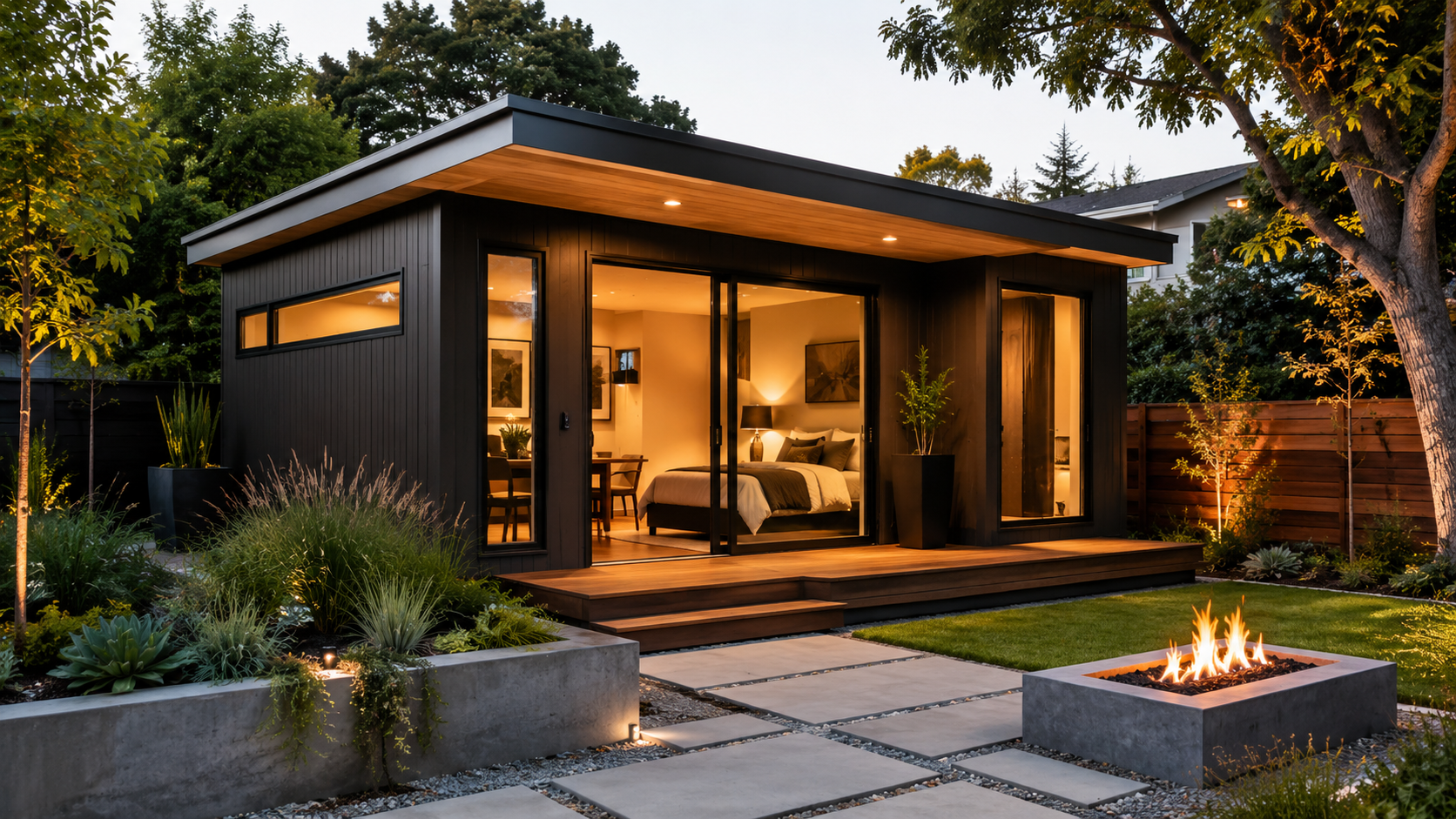
Best prefab paths by project type
Code-built modular ADU
For a permanent dwelling with kitchen, bath and year-round occupancy, a modular unit designed for residential code compliance is often the strongest prefab path. It can reduce on-site construction time, but it does not eliminate permits, foundation work or utility connections.
Finished studio or one-bedroom prefab cottage
A smaller finished unit can work well for guests, a home office or flexible space. Verify whether the local jurisdiction classifies it as a dwelling, accessory building or another use because kitchens and sleeping use can change the rules.
Panelized or kit-based guest house
Panelized systems can provide architectural flexibility while reducing some framing labor. They usually require more local construction management than a fully finished modular unit.
Small-component prefab system
Where a crane, wide-load truck or large module cannot reach the site, systems delivered in smaller components may be more practical even if the on-site assembly period is longer.
The total project cost equation
| Cost category | What can be included |
|---|---|
| Prefab unit | Structure, interior finish, windows, doors, fixtures and sometimes appliances. |
| Freight & set | Transportation, escorts, crane, rigging, staging and placement. |
| Foundation | Slab, piers, crawlspace or engineered foundation. |
| Site work | Clearing, grading, drainage, driveway access and restoration. |
| Utilities | Electrical, water, sewer or septic, gas and communications. |
| Soft costs | Survey, engineering, permits, impact fees, design and inspections. |
Questions to ask every prefab company
- What building code is the unit designed to meet?
- What is included in the advertised price and what is explicitly excluded?
- Who provides the foundation design and who is responsible for site engineering?
- What are the delivery dimensions, weight and access requirements?
- Does the quoted finish include cabinets, counters, flooring, fixtures, HVAC and appliances?
- Who handles permits, utility connections and local inspections?
- What changes are allowed before engineering or production costs increase?
Guest house vs. ADU
The terms are often used loosely online. In many jurisdictions, an ADU is a legally recognized accessory dwelling with specific requirements, while a “guest house” may have different limits on kitchens, occupancy or rental use. The product name on a sales page does not control what the local building department calls it.
Bottom line
For a permanent dwelling, favor manufacturers that can explain code compliance, engineering, delivery and site responsibilities in plain language. A beautiful render is not a permit set, and a low factory price is not the total installed cost. Civilization persists in making land-use rules less photogenic than the brochures.